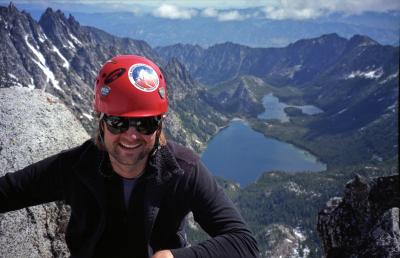
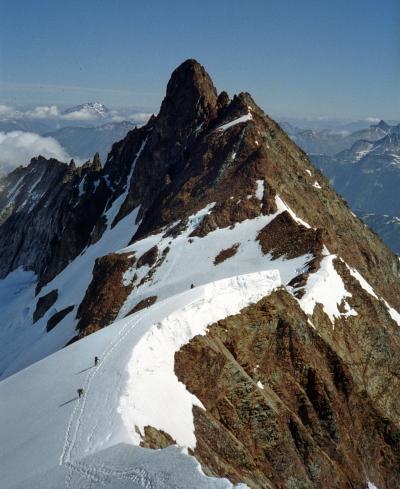
Scott Stephenson would like to take you higher. But unlike Sly and the Family Stone, he doesn鈥檛 need any illegal substances to do it. Stephenson and friend Brian Bongiovanni have written a book, Summit Routes: Washington鈥檚 100 Highest Peaks, that they hope will help the average hiker make it to the top of the state鈥檚 many mountains. The book debuts this month.
At the UW, Stephenson mostly writes software for Computing & Communications鈥� Project Consulting Team. But for the last couple of years he鈥檚 been out in the mountains every chance he gets, doing research for the book. Last summer, for example, he took a leave of absence so that he could make 15 climbs in less familiar areas. Between them, Stephenson said, he and his co-author have done 80 of the climbs in the book. They got information for the rest from fellow climbers.
The list of peaks in the book isn鈥檛 original to Stephenson and Bongiovanni. They got it from the Bulger Climbing Club, a local group that鈥檚 built around the goal of climbing these 100 peaks. Stephenson said it鈥檚 part of a larger trend among climbers called highpointing 鈥� climbing the highest peaks in a defined area, such as the highest one in each of the 50 states.
鈥淚n Washington, it鈥檚 a challenging goal to accomplish because the state has so much wilderness and it鈥檚 so remote and so impenetrable that a lot of the difficulty of the task is not the climb, it鈥檚 just figuring out where the peak is, what maps I need, what trails I need to get to these peaks,鈥� Stephenson said. 鈥淩eally it becomes for each person pursuing this goal a research task.鈥�
That鈥檚 probably why only 20 people so far have managed to climb all 100 peaks, a task that Stephenson said takes, on average, about 10 years.
He knows how hard that is, because he鈥檚 been pursuing the goal himself. In fact, it was the pursuit of the goal that led him and Bongiovanni, who often climbs with him, to write the book.
鈥淲e found ourselves spending so much time on research,鈥� Stephenson said. 鈥淪ome of these peaks are well known; all you have to do is call the ranger station for help. But a lot of them are much more remote and there isn鈥檛 a lot of information about them.鈥�
So, as Stephenson and Bongiovanni accumulated notes, Stephenson began to think about how they could share what they鈥檇 learned with other climbers. He thought at first he would do a set of Web pages, but said the material just seemed to 鈥渢ake on a life of its own.鈥� Pretty soon he was shopping the idea around to publishers.
The book is being published by AlpenBooks Press, the publishing arm of AlpenBooks, a local distributor of books about the outdoors. Stephenson says the book鈥檚 organization is unique. Rather than do a segment on each peak, listing several routes to get to the top, it鈥檚 organized geographically in groups of peaks.
鈥淪o you can make one hike in and set up camp once, then spend a day or two climbing peaks radiating out from that central camp,鈥� he explained. 鈥淚n the book we call those trips slams. And in almost all cases we give only one route up each peak 鈥� the easiest route. We鈥檙e trying to make it accessible to as many people as possible.鈥�
There鈥檚 also an appendix that groups climbs by skill level and by time required.
For Stephenson, the book is really the culmination of a lifelong interest in the outdoors. He grew up in an athletic family who did canoeing, sea kayaking, skiing and hiking together. Stephenson went on his first climbing adventure with an older brother and fell in love with the sport 鈥渂ecause it allowed me to get higher and see these incredible views.鈥�
He became so enthralled, in fact, that he moved to San Francisco from his native Wisconsin primarily for the chance to climb in the Sierras. And it was the lure of the Cascades that brought him to Seattle.
But Stephenson isn鈥檛 such a climbing enthusiast that he has forgotten the average hiker. He emphasized that 15 of the climbs in the book are totally non-technical and can be done by people with no climbing experience. An additional 50 are called scrambles, meaning they don鈥檛 require ropes, but there will be times when you need to climb over boulders or use your hands to pull yourself up. Only 35 are just for experienced climbers.
Of the more familiar peaks, Rainier is Stephenson鈥檚 favorite. 鈥淲hen you set foot on Rainier, you just feel tiny,鈥� he said. 鈥淵ou see it from the city and it鈥檚 big, but when you鈥檙e on it, it鈥檚 like, 鈥極h my God, this thing is enormous.鈥� It鈥檚 such a dynamic environment.鈥�
Stephenson said he chooses Mount Shuksan, in the North Cascades, as his favorite of the lesser-known climbs, and described it as looking 鈥渓ike something out of the Alps 鈥� a very rugged, chiseled mountain with huge glaciers.鈥�
But no matter where he goes, Stephenson considers climbing essential to his mental health. 鈥淚f I go a week or two without being in the mountains, I start getting agitated,鈥� he said. 鈥淲hen I go out in the mountains, I feel that any distractions or stress in my life is instantly gone. I step out there and I鈥檓 so focused on what I鈥檓 doing and the environment around me and my place in the environment that I forget about everything else.鈥�
The book is currently available on the Web through and , and is also sold in the Mountaineers Bookstore and all local REI stores. For more information, go to .