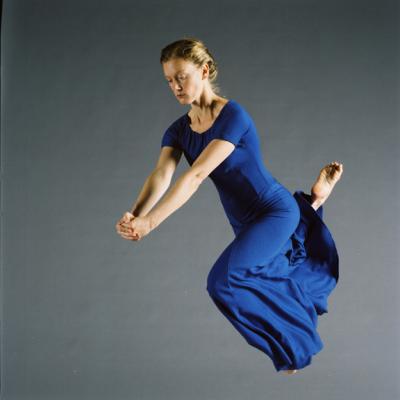
The UW Chamber Dance Company (CDC) will bring to life a 1931 masterpiece by dance great Martha Graham next week, thanks to coaching from one of Graham’s students.
“Dance is like a relay race,” said Diane Gray, who rose from being a member of the Graham company to being director of the Graham school before her retirement. “You go with a piece until you come to somebody else and you pass it on. Dance is just passed from body to body, generation to generation.”
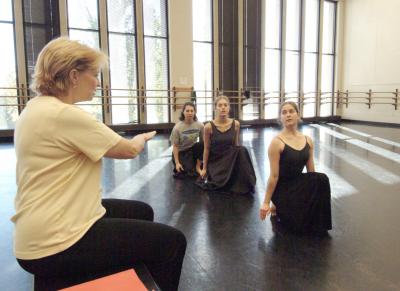
Gray was on campus last October, teaching UW dancers Martha Graham’s technique and setting the basic moves for the dance, a piece for 13 women called Primitive Mysteries. CDC director Hannah Wiley observed Gray with the dancers and took over the direction after her departure.
Wiley said she first saw a film of the dance 20 years ago in New York. “I was captivated by the stark power of the piece and how timeless it seemed,” she said. “And only a few people I have talked to since have ever seen it.”
In fact, the CDC performance will be the West Coast premiere of the work, created by Graham after a trip to the Southwest during which she was impressed by the rituals of the Native Americans there. Gray called the dance “a ritual in three parts, almost like a poem with three stanzas.”
The three parts have titles invoking the story of Christ — Hymn to the Virgin, Crucifixus and Hosannah — but Gray said it’s really “about nothing and no place and no time. It’s about the ritual of people in communion and seeking.”
Gray said the dance was very different from others of the time and that it set the tone not only for Graham’s subsequent work, but for that of many others. And, she added, although it’s now more than 70 years old, “it still is very new because it’s so uniquely about everything.”
To teach the dance, Gray had to first teach the Martha Graham technique that underlies it. It’s a technique, she says, that uses the center of the body as the expressive part, and so requires a strong torso. In a Graham dance, the torso always creates the need for the extremities to move. Classes begin with floor exercises for strengthening, followed by standing exercises to add the element of balance and finally movement, with the emphasis on moving weight through space.
“It’s a wonderful technique that is really very versatile,” Gray said. “It serves as a background to just about any kind of dance you can do. When it’s taught well, you don’t see it. You shouldn’t look like you’re ‘doing Graham.’ That should be your basis but it’s kind of invisible.”
Gray didn’t confine her classes to the movement. The dancers began by seeing a video of Primitive Mysteries, and Gray talked to them about its place in history and about her experiences with Graham. Then, as they learned each part of the dance, she showed the video again so they could see how all the parts fit together.
Gray has been teaching most of her life. The daughter of a dance school teacher, she taught younger students at age 12. But when she started college, she had no intention of pursuing dance as a career. However, during a class in modern dance, she saw the film The Dancer’s World, which featured Graham.
“I was just overwhelmed,” Gray remembered. “I didn’t know anything about dance like that. And based on that film, I packed my bags and went to New York to audition for Juilliard.”
Both Graham and Jose Limon were teaching at Juilliard at the time, and following some friends’ advice, Gray signed up for Limon. But when she arrived, she learned she’d been mistakenly assigned to Graham, and she was too unassertive to protest.
“So that was my career,” she concluded. “It took me rather than I took it.” Gray spent about 30 years off and on with Graham, until Graham’s death in 1991.
So what was the great woman like? According to Gray she was brilliant, passionate and driven, but also funny, with a “droll” sense of timing that made her a delightful, though demanding, person to work with.
“It was the most unbelievable experience just to work with her and create things — whether they worked or didn’t work — just to see how she went about doing things,” Gray said. “To see the example she set for us. She didn’t compromise. When it came to doing something, you did it well or you didn’t do it.”
Now retired, Gray lives in her hometown near Cleveland between stints of teaching and reconstructing Graham dances. It’s only in recent years that dancers outside of the Graham company have been allowed to perform the dances, and Gray recently worked with two other schools on Primitive Mysteries. In return for lower fees, the schools are contributing materials for a packet to be sent out to companies wanting to perform the dance in the future. One school is documenting the floor plans and another is providing video documentation. The UW is responsible for creating costumes that will be available for rental.
Gray said the work is important to her. “Of course it’s a job and it’s a salary but I don’t have to do it,” she emphasized. “I could just stay home and do my quilting or whatever. But I just love setting the works on new dancers. I love trying to bring something of what I got from Martha to others.”
Wiley says that what Gray taught the dancers has stuck. “I feared that some of the intensity and focus that the dancers had embodied while Diane was here would dissipate without her presence,” she said. “They have not. I believe that the movement expresses the content of the dance so purely that simply executing the movement carries the dancers to the level of intensity needed for performance.”
In addition to Primitive Mysteries, the CDC concert will include work by Elisa Monte, Mark Dendy and Hannah Kahn, artists whose creative lives have been influenced by Graham’s work. The concert will be Feb. 3–6 in Meany Hall. Tickets are $16, $12 for students and seniors, and are available from the Arts Ticket Office, 206-543-4880.