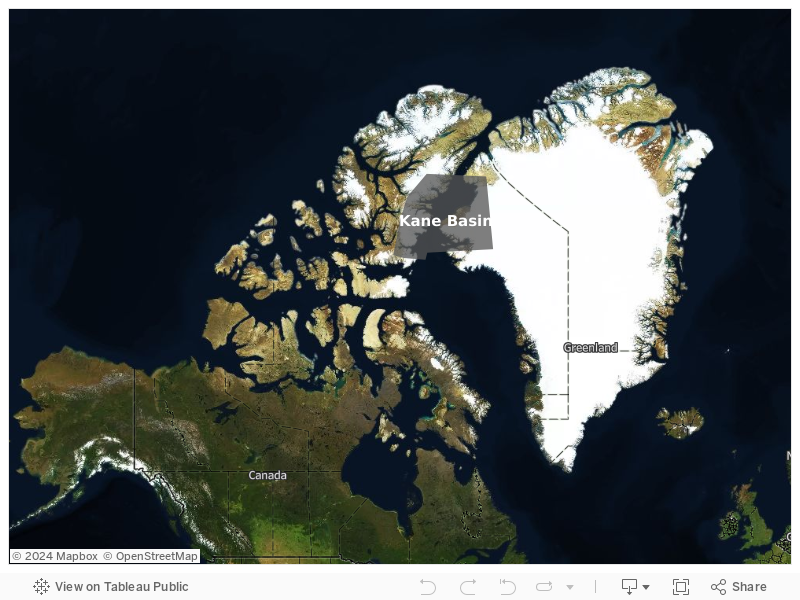
A small subpopulation of polar bears lives on what used to be thick, multiyear sea ice far above the Arctic Circle. The roughly 300 to 350 bears in Kane Basin, a frigid channel between Canada鈥檚 Ellesmere Island and Greenland, make up about 1-2% of the world鈥檚 polar bears.
New research shows that Kane Basin polar bears are doing better, on average, in recent years than they were in the 1990s. The , published Sept. 23 in Global Change Biology, finds the bears are healthier as conditions are warming because thinning and shrinking multiyear sea ice is allowing more sunlight to reach the ocean surface, which makes the system more ecologically productive.
鈥淲e find that a small number of the world鈥檚 polar bears that live in multiyear ice regions are temporarily benefiting from climate change,鈥� said lead author , a polar scientist at the 天美影视传媒 Applied Physics Laboratory鈥檚 Polar Science Center.
If greenhouse gases continue to build up in the atmosphere and the climate keeps warming, within decades these polar bears will likely face the same fate as their southern neighbors already suffering from declining sea ice.
鈥淭he duration of these benefits is unknown. Under unmitigated climate change, we expect the Kane Basin bears to run into the same situation as polar bears in the south 鈥� it鈥檚 just going to happen later,鈥� Laidre said. 鈥淭hey鈥檒l be one of the last subpopulations that will be negatively affected by climate change.鈥�
All of the world鈥檚 19 polar bear subpopulations, including Kane Basin, are experiencing a shorter on-ice hunting season, according to a 2016 study led by Laidre. This makes it hard for the animals, that can weigh more than 1,200 pounds as adults, to meet their nutritional needs. Polar bears venture out on sea ice to catch seals. In summer when the sea ice melts, the polar bears fast on land.
Laidre led a recent study showing that in the Baffin Bay polar bear subpopulation, which includes about 2,800 bears living just south of Kane Basin, adult females are thinner and are having fewer cubs as the summer open-water season 鈥斅� when they must fast on land 鈥斅� grows longer.
鈥淜ane Basin is losing its multiyear ice, too, but that doesn鈥檛 have the same effect on the polar bears鈥� ability to hunt,鈥� Laidre said. 鈥淢ultiyear ice becomes annual ice, whereas annual ice becomes open water, which is not good for polar bears.鈥�
The new paper looked at Kane Basin bears using satellite tracking data and direct physical measurements to compare from 1993 to 1997 with a more recent period, from 2012 to 2016. The body condition, or fatness, improved for all ages of males and females. The average number of cubs per litter, another measure of the animals鈥� overall health, was unchanged.
Satellite tags showed the Kane Basin polar bears traveled across larger areas in recent years, covering twice as much distance and ranging farther from their home territory.
鈥淭hey now have to move over larger areas,鈥� Laidre said. 鈥淭he region is transitioning into this annual sea ice that is more productive but also more dynamic and broken up.鈥�
Observations show a profound shift in the sea ice in Kane Basin between the two study periods. In the 1990s, about half the area was covered in multiyear ice in the peak of summer, while in the 2010s the region was almost completely annual ice, which melts to open water in summer.
Even though there鈥檚 now more open water, the marine ecosystem has become more productive. Annual sea ice allows more sunlight through, so more algae grow, which supports more fish and in turn attracts seals.
鈥淭wo decades ago, scientists hypothesized that climate change could temporarily benefit polar bears in multiyear ice regions over the short term, and our observations support that,鈥� Laidre said.
The subpopulation on the other side of Ellesmere Island, in Canada鈥檚 Norwegian Bay, could be in a similar situation, she said, though no data exist for those animals.
If conditions continue to warm these northernmost polar bears will likely face the same fate as their southern neighbors. Kane Basin polar bears have only much deeper water to turn to farther north.
鈥淚t鈥檚 important not to jump to conclusions and suggest that the High Arctic, which historically was covered by multiyear sea ice, is going to turn into a haven for polar bears,鈥� said Laidre, who is also an associate professor in the UW School of Aquatic and Fishery Sciences. 鈥淭he Arctic Ocean around the North Pole is basically an abyss, with very deep waters that will never be as productive as the shallower waters to the south where most polar bears live.
鈥淪o we are talking about temporary benefits in a limited area and to a very small number of bears.鈥�
Co-authors are , , and at the UW; and Markus Dyck with the Government of Nunavut in Canada; Erik Born with the Greenland Institute of Natural Resources; at the University of Oslo in Norway; and , with Environment and Climate Change Canada.
Major funders include the governments of Canada, Denmark, Nunavut and Greenland; NASA; and the World Wildlife Fund.
For more information, contact Laidre at klaidre@uw.edu.
NASA grant: NNX13AN28G NNX11A063G