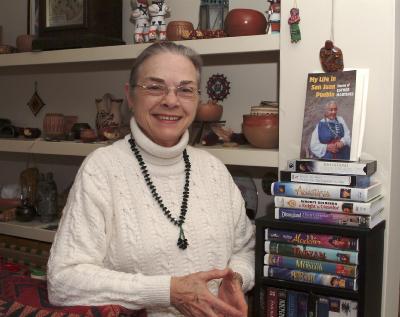
It鈥檚 a notable milestone when any department experiences its first faculty retirement. It marks a passage 鈥� a sort of organizational coming of age.
In the 34 years since the Women Studies Department鈥檚 inception on the UW campus, it has come to earn what might be termed mainstream status. But that word would hardly be fitting to describe Sue-Ellen Jacobs, the department鈥檚 first full-time faculty member and chair, who is retiring at the end of the school year.
Sue-Ellen Jacobs, anthropologist, ethnohistorian, author, teacher, language researcher and evangelist of women鈥檚 issues 鈥� mainstream? Not exactly. Mature, maybe, but she is happily still as outspoken and iconoclastic as ever.
Jacobs, 67, said she first connected with the UW when she was teaching at Sacramento State University, helping to create a women studies department there. It was part of what she called an 鈥渁lmost spontaneous explosion鈥� of such new programs nationwide as the 1960s gave way to the 1970s.
She said she met UW faculty members Laura Newell and the late Carol Eastman in 1971 at the annual anthropology professional meetings, and those two convinced her to come north. Still, it took a couple of years 鈥� she arrived at the UW in the fall of 1974 as an assistant professor of anthropology and the first-ever director of what was then the Women Studies Program. She also is part of the core faculty of the American Indian Studies department, and has done much writing and research on Native American language as well as sexuality and gender roles.
Of those early days, she said, 鈥淚t was a whole new ball game in higher education. We and the folks in American ethnic studies fields were having to make our own way. We were inventing these new disciplines back then.鈥�
Jacobs said the fledgling program focused mainly on the social science aspects of women studies, a different approach than the language and letters-based direction of its sister programs elsewhere.
But not everyone on the UW campus was willing to embrace women studies and grant it credibility and respect back in the 1970s, Jacobs said. Some men became supporters and friends, while others thought the program lightweight and too steeped in advocacy to have true academic significance. Jacobs said this made for an uphill road, early on.
She said she sometimes had to tangle with her own colleagues on behalf of the department, and even hesitated at times to admit to others where her appointment was.
She remembered thinking, 鈥淭hey don鈥檛 get it 鈥� their mothers and daughters are beneficiaries of our work.鈥�
Judy Howard, longtime UW faculty member and current Women Studies Department chair, said, 鈥淭here were suspicions initially, seeing the program as less than rigorous and more about social activism than academic knowledge.鈥�
Others, however, were supportive right away. Among these, Jacobs said, was Ernest Henley, then dean of the College of Arts and Sciences. 鈥淗e got it, big time,鈥� she said, adding that George Beckmann and Donna Gerstenberger, who served as provost and associate dean respectively, also understood and greatly assisted the young program.
Howard, in turn, gives Jacobs similar praise for her hard work, ambition and advocacy over the years.
鈥淪he has fought very hard to have Women Studies established as a program and then a department,鈥� Howard said. 鈥淎nd she has been an intensely loyal member of the department since its inception. She was fundamental to its creation and has done all she can to make sure this place has flourished.鈥�
It has indeed flourished. Starting as an interdisciplinary program in 1970, Women Studies was added as an undergraduate major in 1991 and awarded its first graduate certificate in 1992. The unit was recognized in 1996 as an official department in the Division of Social Sciences in the UW College of Arts and Sciences in 1996, and began a masters and doctoral program 鈥� a true coming-of-age moment for any university department 鈥� in 1998.
About three and a half decades in, Women Studies is a well-respected academic department that employs about 10 full time, tenure line faculty, several lecturers and about 80 adjunct and affiliate members.
Attitudes have changed dramatically toward Women Studies over the years, but have the difficult years passed for good?
Yes and no, Jacobs said with a smile.
鈥淲e are institutionalized, but I don鈥檛 think we are out of danger,鈥� she said. 鈥淭he winds of higher education funding blow hither and yon on things that don鈥檛 have to do with farming, fishing, logging or Boeing.鈥�
(That said, it鈥檚 worth noting that Jacobs herself has written about fishing, in 1989鈥檚 Winds of Change: Women in Northwest Commercial Fishing. It鈥檚 one of 13 academic books and manuals she has written, in addition to scores of book chapters, scholarly articles and multimedia applications.)
Jacobs said a 2002 car accident got her thinking of slowing down and planning for retirement. She already is packing for a move to New Mexico, where she has been doing research for years.
Looking back over her career, Jacobs said her greatest joy has been sharing her knowledge with students and watching her department grow in size and significance.
鈥淚鈥檓 very proud I was able to work with such extraordinary people over these 30 years and see the fruits of a dream I had in 1970 鈥� that someday there would be a graduate program in Women Studies.鈥�
Judy Howard said though the department remains relatively small, the feminist community on campus has grown exponentially over the years and is now quite broad.
鈥淚 think that broader community owes Sue-Ellen a great deal,鈥� Howard said. 鈥淲omen Studies wouldn鈥檛 be here without her.鈥�
A retirement, a new book and an endowment:
The Women Studies Department will celebrate the retirement of Sue-Ellen Jacobs and the creation of an endowment in her name in a reception 6鈥�10 p.m. Friday, April 30, in the Walker-Ames Room of Kane Hall. RVSPs appreciated by Friday, April 23, at 206-543-6900 or by e-mailing womenst@u.washington.edu .
For more information on the 鈥淪ue-Ellen Jacobs Founders Fund Endowment,鈥� visit online at or contact Judy Howard, department chair, at 206-543-6900 or jhoward@u.washington.edu .
The gathering also will mark the release of Jacobs鈥� latest book, My Life in San Juan Pueblo: Stories of Esther Martinez, published by University of Illinois Press. The cost is $24.95, and includes a CD of stories as well.