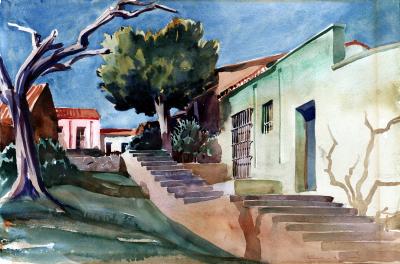
Jeffrey Ochsner is looking for a few good paintings. Actually, he鈥檇 like a lot of good paintings, or even mediocre paintings, any paintings at all, as long as they were done by a former UW architecture professor named Lionel Pries.
Ochsner, a professor of architecture himself, is writing a book about Pries, who taught here from 1928 to 1958. And though the man was known mainly as a teacher and secondarily as an architect, he also was an artist who exhibited his work in prestigious venues such as the Henry Art Gallery and the Seattle Art Museum. Ochsner needs to find his paintings because of what they鈥檒l tell about Pries, and in a larger sense, what they鈥檒l tell about Northwest art.
鈥淭o even attempt to understand what Pries is doing, you have to be able to see the work,鈥� he says. 鈥淵ou have to build a visual record and then you can start to date them, look for influences, etc.鈥�
The search is an unfamiliar one for Ochsner, an architectural historian. With buildings, he says, it鈥檚 simple: There鈥檚 an address for the building and it鈥檚 either there or it鈥檚 been demolished. Paintings, on the other hand, are often in private hands, and they could be anywhere. The task is complicated by the fact that Pries was not a famous artist and he often gave his work away.
Just who was Lionel Pries? He was a dominant force in the UW architecture department for the first 20 years of his time here, when the school was small and he taught virtually every student. The list of famous alumni of his classes includes Minoru Yamasaki and Victor Steinbrueck, among others. He was revered enough by his students that The College of Architecture and Urban Planning later established both a lecture and a teaching award named after him.
Which is where Ochsner first heard of him after his arrival at the UW in 1988. Then he was asked by the local chapter of AIA to create a book in honor of its 100th anniversary in 1994. So Ochsner, working with others, gathered and edited a series of essays about notable Seattle architects into a book called Shaping Seattle Architecture.
鈥淲hen the contributors were sitting around talking about who should be included in the book, I asked about Pries and everybody said yes, of course he should be in it,鈥� Ochsner recalled.
So he paid a visit to the UW Libraries鈥� Special Collections and had a look at some Pries drawings on file there. He was impressed enough that he not only included Pries in Shaping Seattle Architecture, but also decided that he would do further research on Pries when that book was done.
Although Ochsner did do some interviews with Pries students, the bulk of the project was delayed while he served a term as chair of architecture and completed another book about the influence in Seattle of architect H.H. Richardson. But finally, about a year ago, he began the work in earnest.
What I didn鈥檛 realize when I started was the degree to which Pries was friends with Morris Graves, Guy Anderson and Ken Callahan, three of the dominant figures in Northwest art at the time,鈥� Ochsner said. 鈥淎nd I didn鈥檛 understand Pries鈥� involvement with the Art Institute which was the precursor of the Art Museum 鈥� he was director.鈥�
Then Ochsner learned that Pries was exhibiting in many shows in the 1930s and that he had a solo exhibit in the Henry Gallery in the 1940s. When he showed local gallery owner David Martin the one Pries painting that the Seattle Art Museum owns, Martin was impressed. 鈥淭his guy could really paint,鈥� he told Ochsner.
And that confirmed for Ochsner the importance of finding more of Pries鈥� work. Right now he can look at the art museum鈥檚 painting, as well as one owned by the College of Architecture and Urban Planning. And there are a number of drypoint prints in Special Collections. But Ochsner knows there are other paintings out there, and he鈥檇 like to find them. He asks that anyone who can show him a painting or give him a tip on where to find one contact him by e-mail, jochsner@u.washington.edu.
鈥淲e鈥檒l take slides and scans of the work and return it to the owners,鈥� he says. 鈥淚鈥檓 writing a biography, but it would be nothing without illustrations of the work. I hope that anyone who knows something about the paintings will be willing to pass on that information.鈥�