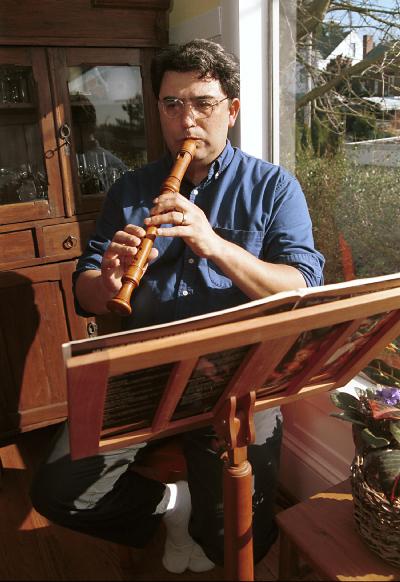
You might call Kim Pineda a Renaissance man, but you wouldn鈥檛 have the period quite correct. Pineda has been known to cast about in eras from the medieval to the classical, but his favorite is just a little after the Renaissance 鈥� the Baroque, to be exact (1600-1750). He鈥檚 the director and one of the founders of a musical ensemble called the Benevolent Order for Music of the Baroque.
Of course at the UW, Pineda is firmly grounded in the 21st century. He serves as a secretary at the National Registry for Ichthyosis and Related Disorders, which is part of the Dermatology Department. But during his free time, he plays his transverse flute and recorder 鈥� both Baroque instruments 鈥� for audiences in Seattle and around the country.
鈥淭he freedom is what appeals to me about Baroque music,鈥� Pineda says. 鈥淚n that era, most of the musicians were both performers and composers, so you often get something that鈥檚 a skeletal outline of a piece and you鈥檙e expected to put in 50 percent of the music. I like being able to color outside the lines, to take the printed page as a point of departure.鈥�
Pineda was in graduate school at Indiana University when he formed the ensemble with some friends in 1993. At the time, the name was chosen deliberately to get the acronym BOMB, but these days, understandably, they don鈥檛 want to use it. Still, it鈥檚 an indication of the kind of group it is. Go to one of their concerts and you鈥檒l see men wearing black suits with black T-shirts instead of the usual tux. The women can wear anything they like as long as it鈥檚 black. However, the basic black is accessorized with colorful socks.
鈥淚 got tired of going to concerts where people looked like they were just going through the motions,鈥� Pineda says. 鈥淭hey go out there and they wear their formal wear 鈥� 19th century types of clothing 鈥� and they play the music in a very regulated manner. It鈥檚 fine playing, a lot of it, but it seemed like a corporate kind of attitude.鈥�
So Pineda and his group decided to break out of the mold 鈥� not only with what they wear but with how they present the music. Pineda likes to talk directly to the audience, telling them stories about the music and the composers. He鈥檚 especially fond of the juicy tidbits, like the composer who was stabbed to death with an engraving tool, probably by his wife, or the composer who was locked out of the house after coming home drunk one too many nights and died of exposure.
鈥淢ost people don鈥檛 know anything about the composers of the music, and I think it鈥檚 interesting to learn about their foibles,鈥� Pineda says. 鈥� I also think it鈥檚 important to communicate with the audience beyond the playing.鈥�
None of this implies that the group doesn鈥檛 take the music seriously. On the contrary, their advertising material stresses that they have fun while never violating the integrity of the music. And it was Pineda鈥檚 embrace of an instrument that is rarely taken seriously that started him on his musical career in the first place.
He was about 10 when he saw a Windex commercial on TV that featured recorder music in the background. Attracted to the sound, he got his first recorder at the age of 12. Although elementary school children are often introduced to music through the recorder, Pineda insists it鈥檚 not a toy. 鈥淚 practiced diligently because no one told me it was easy to play,鈥� he says.
But there were no parts for recorders in the school orchestra, so Pineda played clarinet in junior high. It wasn鈥檛 until he became an undergraduate music major at California State University, Northridge that he returned to the recorder. Ironically, he played in both the early music and new music ensembles there because there was almost no recorder music written from the end of the Baroque era until the 1930s, when it became popular again.
Thus was born his interest in Baroque music and Baroque instruments, which led him to the Baroque 鈥� or transverse 鈥� flute, the instrument he most often plays today. It differs from its modern relatives, he says, in that it鈥檚 made out of wood and has a conical rather than a cylindrical bore. In other words, its opening is larger at the mouthpiece end. And it has only one key; other notes are played by covering or uncovering holes in the instrument.
Pineda didn鈥檛 discover the flute until just before graduate school, when he heard one played and was 鈥渃aptivated by the sound.鈥� He switched over to that instrument and earned a master鈥檚 in musicology with an emphasis on historical performance practice. He went on for the doctorate but stopped short of completion, moving to Seattle in 1995 to concentrate on performing and teaching. That鈥檚 when started working at the UW.
鈥淚 often help people feel warm and fuzzy,鈥� Pineda says about the job, which often involves talking to distressed parents who have just learned their young children have a genetic skin disorder called ichthyosis. 鈥淚t鈥檚 never boring, and I like the personal contact I have with people.鈥�
So although his group is thriving, thanks to some key support from the Early Music Guild, Pineda isn鈥檛 thinking about full-time performing.
鈥淵ou spend a lot of time with musicians and you get lost in an alternate reality,鈥� he says. 鈥淭he job is a good perspective keeper.鈥�
Pineda will be performing a solo flute and recorder recital 鈥� assisted by William Skeen on cello and viola da gamba and Jack Ashworth on harpsichord 鈥� at 8 p.m. Saturday, April 5 and 3 p.m. Sunday, April 6 at Bethany Lutheran Church, 7400 Woodlawn Ave. N.E. Tickets are $20, $15 for students and seniors and are available from Baroque Northwest, 206-328-2614.