Man doth not live by bread alone, but also by sodium, calcium, potassium, and magnesium. If the Bible had a chapter on basic cell biology, the preceding quote might have been included.
Human cells must control the movements of electrically charged particles called cations in order to perform their most basic functions. Under normal conditions, the most abundant cations outside of cells are sodium, calcium, and magnesium, while the most abundant cations inside cells are potassium and magnesium.
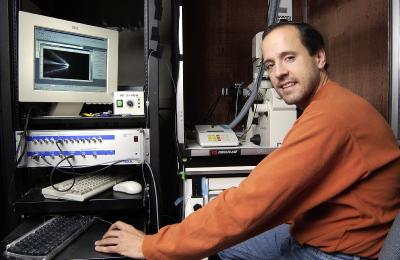
Dr. Andrew Scharenberg, assistant professor of pediatrics and adjunct assistant professor of immunology, and his lab group are interested in understanding how one of those cations, magnesium, gets into and out of cells.
鈥淢agnesium has a unique role inside cells in that it attaches to adenosine triphosphate, also known as ATP, the energy molecules that do work in every living cell,鈥� says Scharenberg. 鈥淢ost enzymes which use ATP for energy need the magnesium-bound form, so making sure the right amount of magnesium is present is a very basic and critical cellular function. However, it is poorly understood how magnesium is taken up into cells and how the amount taken up is regulated.鈥� He adds, 鈥淧eople have studied the uptake of magnesium using radioisotopes and by making measurements of the total amount of magnesium, but nobody has been able to molecularly identify the proteins involved in the process.鈥�
Scharenberg鈥檚 lab has identified the first protein, TRPM7, that has a clear role in mediating magnesium uptake into cells. Special properties of TRPM7 are that it forms both an ion channel (a pore in the cell wall for magnesium to move through) and a protein kinase (an enzyme which modifies other cellular proteins). What this means outside of the lab is that drugs may one day be developed to alter the function of TRPM7 to selectively allow rapid magnesium uptake in cells.
鈥淭his is potentially medically important because altering magnesium homeostasis is something that physicians actually use therapeutically in some situations,鈥� says Scharenberg. 鈥淔or example magnesium sulfate therapy has long been used to treat preeclampsia.鈥�
Women in late pregnancy can develop a serious condition called preeclampsia, which results in high blood pressure, edema, muscle contractions and even death if the condition of the woman is not treated.
鈥淢agnesium sulfate provides the patient with increased levels of magnesium in the blood, which presumably acts at least in part by being taken up into the body鈥檚 smooth muscle cells and causing them to relax. A potentially more effective therapy would be to directly enhance magnesium uptake into cells in the smooth muscle tissue, as a drug able to activate TRPM7 might allow,鈥� says Scharenberg.
Another possible use for identifying proteins involved in magnesium uptake is for treating asthma. During an asthma attack there is a severe constriction of the smooth muscle tissue in the lungs.
鈥淢agnesium sulfate has also been studied for the treatment of severe asthma, with variable results,鈥� explains Scharenberg. 鈥淭his is all speculative, but selectively applying drugs in an inhaled fashion that would allow magnesium uptake in the smooth muscle of the bronchus should produce relaxation of the bronchi and bring relief to the patient.鈥�
Scharenberg became interested in magnesium uptake while working as an immunologist and seeing children with single-gene immune deficiencies. The line of investigation which led to the identification of TRPM7 began with a comparison of genomic data of Caenorhabditis elegans, a soil nematode, with that of human lymphocytes to identify new proteins with some similarity to known ion channels.
鈥淚n the process of characterizing TRPM7, we knocked it out of a cell line,鈥�
Scharenberg says. 鈥淭he cells in that line died, and we were stuck for a long time. The breakthrough that happened almost serendipitously was finding that if you provide a supplemental amount of magnesium to cells deficient in this particular protein, they would grow. Now we鈥檙e able to use these cells to understand the mechanisms the body uses to control magnesium uptake into cells.鈥�
Scharenberg presents the New Investigator Science in Medicine lecture
鈥淢agnesium Homeostasis and Dual Function Ion Channel/Protein Kinases,鈥� at noon, Thursday, Dec. 5 in D-209 Turner Auditorium, Health Sciences Building.
Scharenberg received a M.D. in 1990 and completed a pediatrics residency at the University of North Carolina School of Medicine in 1993. He served as a postdoctoral fellow in Dr. Jean-Pierre Kinet鈥檚 laboratory at the National Institutes of Health and at the Division of Experimental Pathology at Beth Israel Hospital until 1998. Scharenberg was on the faculty at Harvard Medical School for two years and joined the UW Department of Pediatrics in 2000. Among his numerous awards, Scharenberg received a Pediatric Scientist Development Award in 1993 and the 2002 American Pediatric Society National Young Investigator Award.