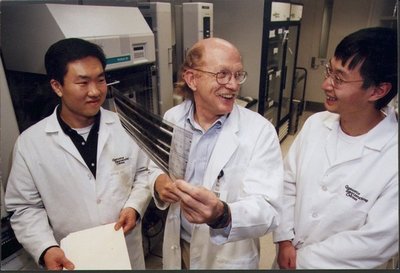
Dr. Robert H. Waterston, one of the world鈥檚 leading genome scientists, has been named chair of the Department of Genome Sciences at the UW School of Medicine, announced Dr. Paul G. Ramsey, UW vice president for medical affairs and dean of the School of Medicine.
The appointment follows a national search and is subject to confirmation by the UW Board of Regents at its meeting July 19. Ramsey also announced that Waterston will hold the William Gates III Endowed Chair in Biomedical Sciences.
Waterston, 58, is the James S. McDonnell Professor and head of the Department of Genetics at Washington University School of Medicine in St. Louis, as well as director of the school鈥檚 Genome Sequencing Center.
Waterston, who is expected to start at the UW next January, brings an impressive set of credentials to Seattle. His most recent honors include being one of the eight people named to receive the 2002 International Gairdner Award in recognition of outstanding achievement in biomedical research. In moving to the UW, he joins two other 2002 Gairdner recipients in Genome Sciences, Drs. Maynard Olson and Philip Green. (Olson came to the UW in 1992; Green arrived in 1994.)
Waterston also is a member of the National Academy of Sciences, and has won the Genetics Society of America鈥檚 Beadle Award and the first Dan David Prize for achievements that hold great promise for improving the future. Other recent honors include the Alfred P. Sloan Award from the General Motors Cancer Research Foundation and election to the Institute of Medicine.
鈥淲hen a scientist of Robert Waterston鈥檚 stature decides to come to the 天美影视传媒, it is a tremendous compliment to our institution and to those already here who are working in related areas,鈥� said UW President Richard L. McCormick. 鈥淒r. Waterston鈥檚 research in St. Louis has gained the acclaim of colleagues worldwide. We look forward to having him lead our outstanding genome sciences department to even greater heights.鈥�
Similar enthusiasm was expressed by Ramsey. 鈥淏ob Waterston鈥檚 arrival in Seattle will reunite a team of genome scientists who all worked together formerly at Washington University, including Maynard Olson and Phil Green,鈥� Ramsey said. 鈥淭ogether with many other UW colleagues, Bob Waterston is certain to further cement the UW鈥檚 growing reputation as the epicenter of one of the most exciting fields of biomedical inquiry today.鈥�
鈥淏ob Waterston played a crucial role in the world鈥檚 first sequencing of the genome of an entire living organism, and he has a visionary understanding of the revolution that is taking place in the convergence of information technology and bioscience,鈥� said William H. Gates III. 鈥淚 am delighted that he is coming to Seattle to lead the Department of Genome Sciences at the 天美影视传媒 School of Medicine. The recruitment of Bob Waterston positions our community to be a global leader in genomics.鈥� Gates is chairman and chief software architect of Microsoft Corporation.
鈥淚 am delighted to join the 天美影视传媒 as the chair of the new Department of Genome Sciences,鈥� Waterston said. 鈥淭his is an exciting time in genome sciences, and the combination of the department, the University and the community offers a special opportunity to shape the direction of this important field. I am honored to be given this chance and look forward to the challenge.鈥�
The UW Department of Genome Sciences was formed in October 2001, with the consolidation of the former Department of Genetics in the College of Arts and Sciences and the former Department of Molecular Biotechnology in the School of Medicine. There are about 20 faculty in the department, with roughly 20 additional affiliate and adjunct faculty. The acting chair has been Dr. Stanley Fields, professor of genome sciences and medicine, who Ramsey thanked for his interim leadership.
Waterston joined the Washington University faculty in 1976 after a postdoctoral fellowship at the Medical Research Council Laboratory of Molecular Biology in Cambridge, England. He had previously been an intern in pediatric medicine at Children鈥檚 Hospital Medical Center in Boston. Waterston received both a medical degree and a doctorate in pathology from the University of Chicago in 1972 after earning a bachelor鈥檚 degree in engineering from Princeton University in 1965.
Through his leadership of the project to sequence the genome of the worm C. elegans, Waterston was the first to make complete sequencing of animal genomes a reality. In the years that followed, his contributions to large-scale DNA sequencing were central to the success of the Human Genome Project. His laboratory constructed the physical map that was the framework of the international human genome sequencing effort, then contributed 20 percent of the entire human genome sequence.
Waterston also pioneered the use of the Internet for the rapid, public release of sequence and map information.
In order to help investigators worldwide interpret the genome sequence, Waterston led the effort to generate more than 3 million sequences from expressed genes in a variety of organisms. This vast databank now enables researchers to find genes important to complex human traits by exploiting the evolutionary origins of the critical genes.
Waterston also led the effort to identify millions of DNA sites at which one person differs from another. These variant sites form a genetic map that enables the identification of human disease genes.
As a biologist, Waterston has long been interested in the development of muscle. He used the worm to study muscle formation, identifying many of the required genes and creating a model of the lattice of myofilaments of which muscle is composed. This biological question led to development of new tools for gene recovery and ultimately the map and sequence of C. elegans.
Waterston held an American Heart Association Established Investigator Award from 1980 to 1985, and a John Simon Guggenheim Fellowship from 1985 to 1986. He has served as a member of several National Institutes of Health study sections, on the NIH Advisory Council and as chairman of the NIH Molecular Cytology Study Section.
Waterston is a member of Sigma Xi, Alpha Omega Alpha, the Genetics Society and the American Society of Cell Biology.
The Department of Genome Sciences will have nine members of the National Academy of Sciences, with the arrival of Waterston. More information about the department is available at .
Additional information about Waterston鈥檚 background and scientific accomplishments can be found at
and